

India’s New Critical Minerals Exploration & Recovery Policy 2025: Boosting Resource Security
Have you ever taken a minute to think about what really powers the world, not the power source, but the raw material that powers the electric car, the solar panel, the smartphone, or the wind turbine, and most importantly, where it is really coming from. As discussions around India’s critical minerals exploration policy gain momentum, questions around resource security, domestic capability, and even the role of a critical minerals testing laboratory become increasingly relevant.
India’s dependence on imported raw materials is not a new concern, and the need for reliable mineral analysis services in India is becoming more important as exploration expands. However, 2025 is the year when the scenario is going to change. With the launch of the Critical Minerals Exploration & Recovery initiative under the National Critical Mineral Mission, the country is now moving ahead in leaps and bounds towards a self-sufficient era.
By the end of this article, you will get a clear idea about the policy, the investments, and the future of the country.
Why Critical Minerals Have Become Strategic Assets
Critical minerals are not critical or rare because they are not available in large quantities; they are critical because the raw material is difficult to process, and the demand is increasing exponentially.
Let’s discuss some critical raw materials, like lithium, cobalt, nickel, rare earth, and graphite. India’s problem is that the dependence on these raw materials is high, sometimes touching 80-90%.
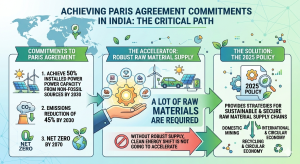
However, the commitment towards the Paris Agreement is also there:
- Achieve 50% of installed power capacity from non-fossil sources by 2030
- Emissions reduction of 45% by 2030
- Net zero by 2070
For this, a lot of raw materials are required, and without a robust raw material supply, the clean energy shift is not going to accelerate. At this point, the 2025 policy comes into the picture.
Anacon’s Role in Recycling Ecosystems
Recycling is not just collection, it’s science.
Anacon Laboratories enables recycling companies to:
- Analyze material purity and composition
- Ensure safe processing of hazardous components
- Maintain quality standards for reused minerals
- Support circular economy goals with verified data
How do you ensure the minerals discovered are viable, safe, and usable?
Anacon Laboratories supports this ecosystem by:
- Providing accurate mineral composition analysis
- Ensuring compliance with environmental and regulatory standards
- Supporting decision-making for mining and processing companies
- Delivering reliable lab data for project feasibility
The National Critical Mineral Mission: What’s Actually New?
The approval of the National Critical Mineral Mission in 2025 is not a routine policy update. It’s a structured, multi-year financial and regulatory push.
Here are the numbers that matter:
- ₹34,300 crore total mission outlay over seven years (2024–2031)
- ₹16,300 crore direct government expenditure
- Remaining funding mobilised through PSUs and private participation
- 1,200 exploration projects planned by 2030
- 24 minerals officially classified as critical
This classification gives the Central Government authority to directly auction blocks and speed up development under amendments to the MMDR Act.
The Geological Survey of India has already expanded its field programmes significantly compared to previous years, focusing on lithium, rare earth elements, potash, graphite, and base metals in underexplored belts.
What’s different this time is the coordination. Exploration, regulatory clearance, downstream processing, and recycling are being treated as one integrated ecosystem rather than isolated efforts.
From Waste to Resource: A Smarter Extraction Strategy
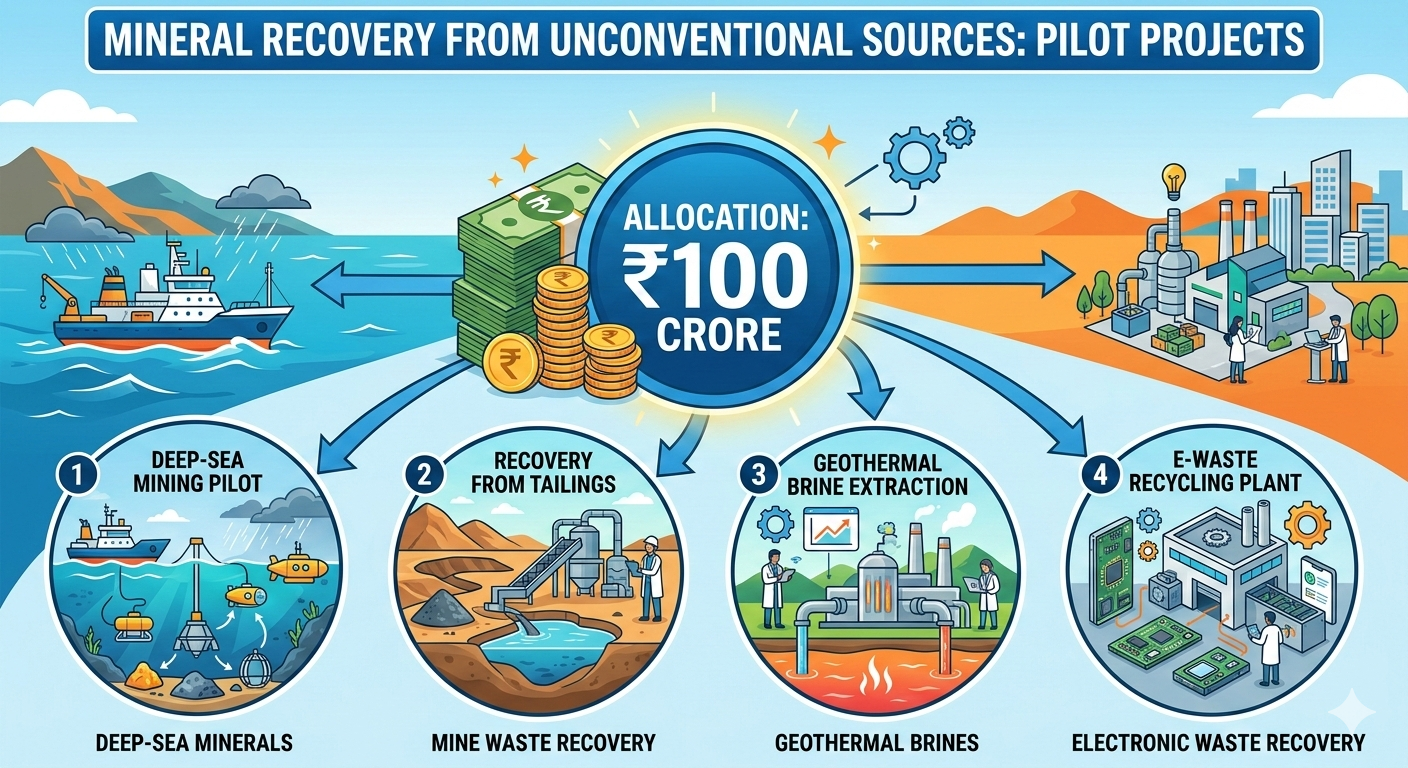
One of the most interesting parts of the 2025 approach is the focus on recovery from secondary sources. Instead of looking only at new mines, the government is funding pilot programmes to extract critical minerals from:
- Mine tailings
- Fly ash
- Red mud from alumina plants
- Overburden material
- Industrial waste streams
An allocation of ₹100 crore has been earmarked for pilot projects dedicated to mineral recovery from such unconventional sources.
Why does this matter?
Because India already has decades of mining and industrial residue. Much of it contains low-grade but economically recoverable traces of rare earth elements and other strategic minerals earlier ignored due to technological or economic constraints. With improved metallurgical processes and solvent extraction techniques, these “waste” sites could become secondary mineral hubs.
Recycling as a Strategic Pillar
Another major dimension of the 2025 policy is recycling.
India generates significant volumes of electronic waste and is witnessing rapid growth in lithium-ion battery consumption. Instead of importing refined minerals again and again, the government aims to create domestic recycling infrastructure.
Key policy signals include:
- ₹1,500 crore incentive support for recycling development
- Target of building 270 kilotons annual recycling capacity
- Potential recovery of around 40 kilotons of critical minerals annually
- Expected private investment inflow of nearly ₹8,000 crore
- Estimated employment generation of 70,000 jobs
Customs duties on scrap and waste containing critical minerals have also been removed in the 2025–26 budget to encourage domestic processing. This indicates a shift toward a circular economy, thinking of securing supply not only from the earth, but from end-of-life products.
Global Footprint Expansion
Domestic exploration alone cannot fully meet projected demand. That’s why India is also securing overseas mineral assets. Through Khanij Bidesh India Ltd (KABIL), India has acquired exploration rights over 15,703 hectares of lithium-bearing land in Argentina’s Catamarca province, part of the global lithium triangle. India has also joined the Minerals Security Partnership (MSP) to collaborate with like-minded countries in diversifying supply chains. This dual strategy domestic exploration plus overseas asset acquisition reduces geopolitical risk.
What This Means for India’s Industrial Future?
The 2025 policy is not just about mining more minerals. It’s about securing industrial continuity.
Critical minerals are foundational for:
- EV manufacturing
- Renewable energy expansion
- Defence electronics
- Semiconductor fabrication
- Advanced manufacturing
Without supply assurance, industrial growth slows. With it, India can strengthen its position in global manufacturing and technology value chains. The structured financial backing, regulatory reform, recycling incentives, and global partnerships together signal a long-term strategy not a short-term reaction.
How Anacon Laboratories Helps Clients Succeed?
Anacon supports industries by offering:
- End-to-end mineral testing solutions
- Environmental and compliance analysis
- Advanced laboratory support for exploration and recovery projects
- Accurate data for faster, smarter decision-making
This ensures businesses don’t just meet standards, they stay ahead.
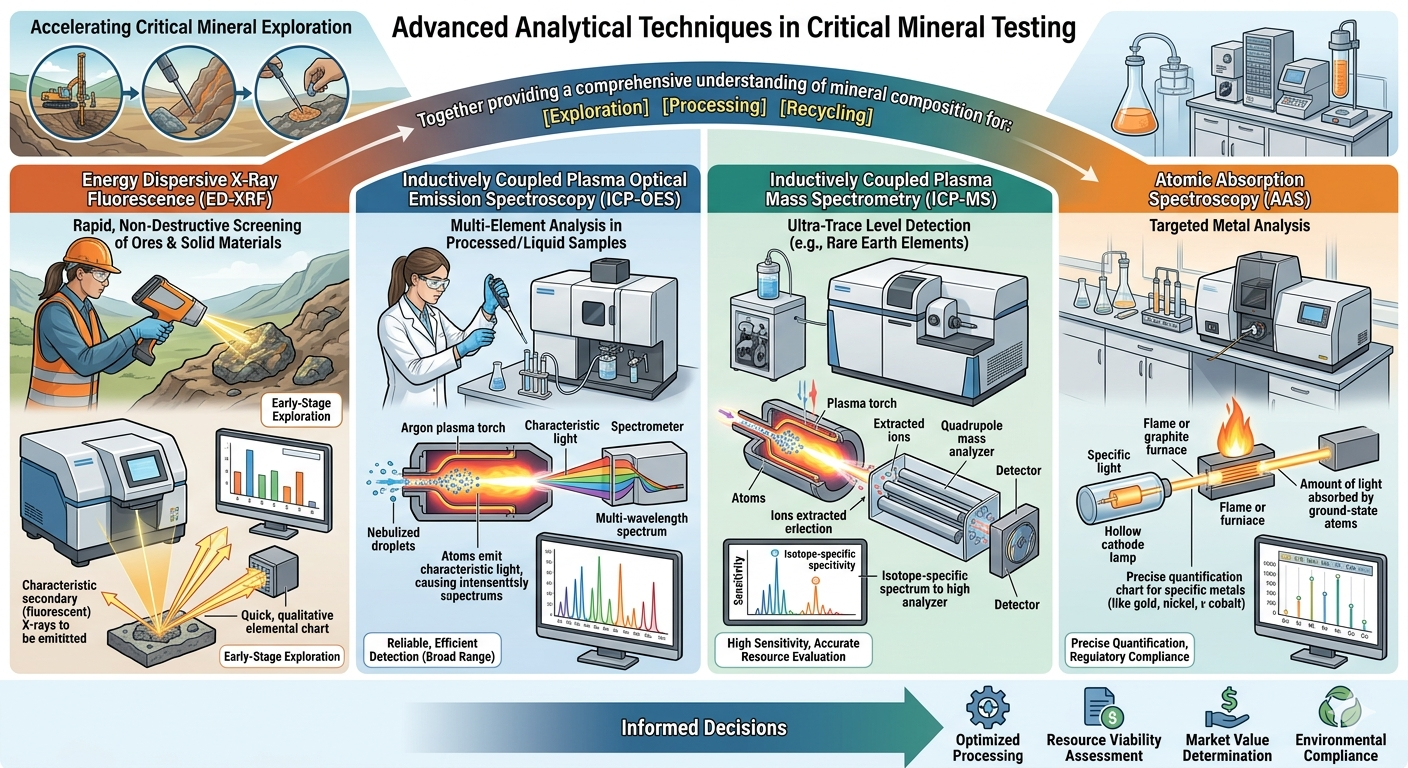
Advanced Analytical Techniques in Critical Mineral Testing
As exploration of critical minerals accelerates, accurate analysis becomes essential to determine resource viability, composition, and compliance. This requires a combination of advanced techniques, each serving a specific role across the testing process.
- For rapid, non-destructive screening of ores and solid materials, Energy Dispersive X-Ray Fluorescence (ED-XRF) is widely used, enabling quick elemental analysis during early-stage exploration.
- For multi-element analysis in processed or liquid samples, Inductively Coupled Plasma Optical Emission Spectroscopy (ICP-OES) provides reliable and efficient detection across a broad range of elements.
- For ultra-trace level detection, especially in rare earth elements, Inductively Coupled Plasma Mass Spectrometry (ICP-MS) offers high sensitivity and precision, supporting accurate resource evaluation.
- Additionally, Atomic Absorption Spectroscopy (AAS) is used for targeted metal analysis, ensuring precise quantification and regulatory compliance.
Together, these techniques provide a comprehensive understanding of mineral composition, enabling informed decisions across exploration, processing, and recycling.
Conclusion
India’s Critical Minerals Exploration & Recovery Policy 2025 reflects a deeper understanding: energy transition and industrial growth cannot happen without mineral security. By allocating ₹34,300 crore, planning 1,200 exploration projects, supporting recycling infrastructure, and expanding global partnerships, India is actively building resilience into its supply chain architecture.
The next decade will reveal how effectively these plans convert into production capacity but the intent is clear: move from dependency to strategic control. For industries requiring accurate mineral testing, environmental compliance analysis, or advanced laboratory support in resource projects, connect with Anacon Laboratories today.